









Weeks.
Not years.
Web applications for small and medium businesses.
I ship any application to production in weeks — not months.
prorok.pl — a complete SaaS (LLM + computation engine + billing) built solo in ~6 weeks and running in production. 15+ years of engineering (CGI · KPMG · Acxiom), staff-level front-end, my own agent infrastructure. Consulting and training in AI-augmented development.
 CGI
CGI KPMG
KPMG
Pick who you are.
Same craft, different language. Point at your case — I'll show you exactly what I can build for you.
Your business works while you sleep.
In services, the win goes to whoever the client trusts — and whoever replies first. I build your company's digital presence so it looks solid, collects inquiries on its own and takes the manual work off your plate — from first message to booked appointment.

A website that builds trust
A professional site, local SEO and an inquiry form. Clients see a real business and leave their contact details instead of going to a competitor.
Automated quotes and requests
An AI assistant collects the inquiry, drafts an initial quote and proposes a time slot — after hours too. You reply to a ready draft instead of starting from scratch.
A back office built for your trade
Property-management tickets, crew schedules, a client database. A dedicated system for the moment Excel and e-mail start falling apart.
Content that brings in work
For services and digital creators: content and campaigns that build the brand and a steady stream of clients. No one-off pushes.
Proof, not promises
The numbers speak for themselves.
from first commit to a full SaaS in production (solo)
commits in that time
staging → production (Infrastructure-as-Code)
years of engineering — Tech Lead: CGI, KPMG, Acxiom
public open-source tools (MCP / CLI)
fewer tokens on documents (macos-vision-mcp)
Three disciplines, one workshop
Team velocity.
Single-person coherence.
Most companies are still figuring out how to fold AI into software delivery in a way that makes sense. I've been doing it since 2024: orchestrating fleets of agents that write, test and ship code under my architectural supervision.

AI agent
orchestration
Agents bring the volume, I keep the architecture and quality. It multiplies velocity — without “vibe coding”.

Infrastructure
as Code
The whole stack written as code: auth, billing, CI, deployment. Staging → prod in minutes, no “we'll fix it later” debt.

Design systems
+ UX
Staff-level front-end. Speed doesn't have to eat quality — two things I bring together.
How I work
“I see a problem, I build a tool,
I use it every day.”
Not a slogan — a daily way of working. When I spot a recurring problem, a tool that solves it exists by the end of the same day. That's how I built my own agent infrastructure: MCP servers, open-source libraries, pipelines used on every project.
Most companies are still learning to fold AI into software delivery — I've been doing it since 2024, when I rolled out GitHub Copilot in my team. Today I orchestrate fleets of agents that write, test and ship code under my supervision.
Selected work · Flagship
One proof. The whole thesis.
prorok.pl — a full SaaS platform (astrology + LLM), built solo. A WASM engine (Swiss Ephemeris), streaming LLMs (Vercel AI SDK + Claude), a custom Clerk↔Supabase auth bridge, Stripe billing, PWA, the entire stack as Infrastructure-as-Code, security CI. One verifiable, clickable proof of the whole thesis.
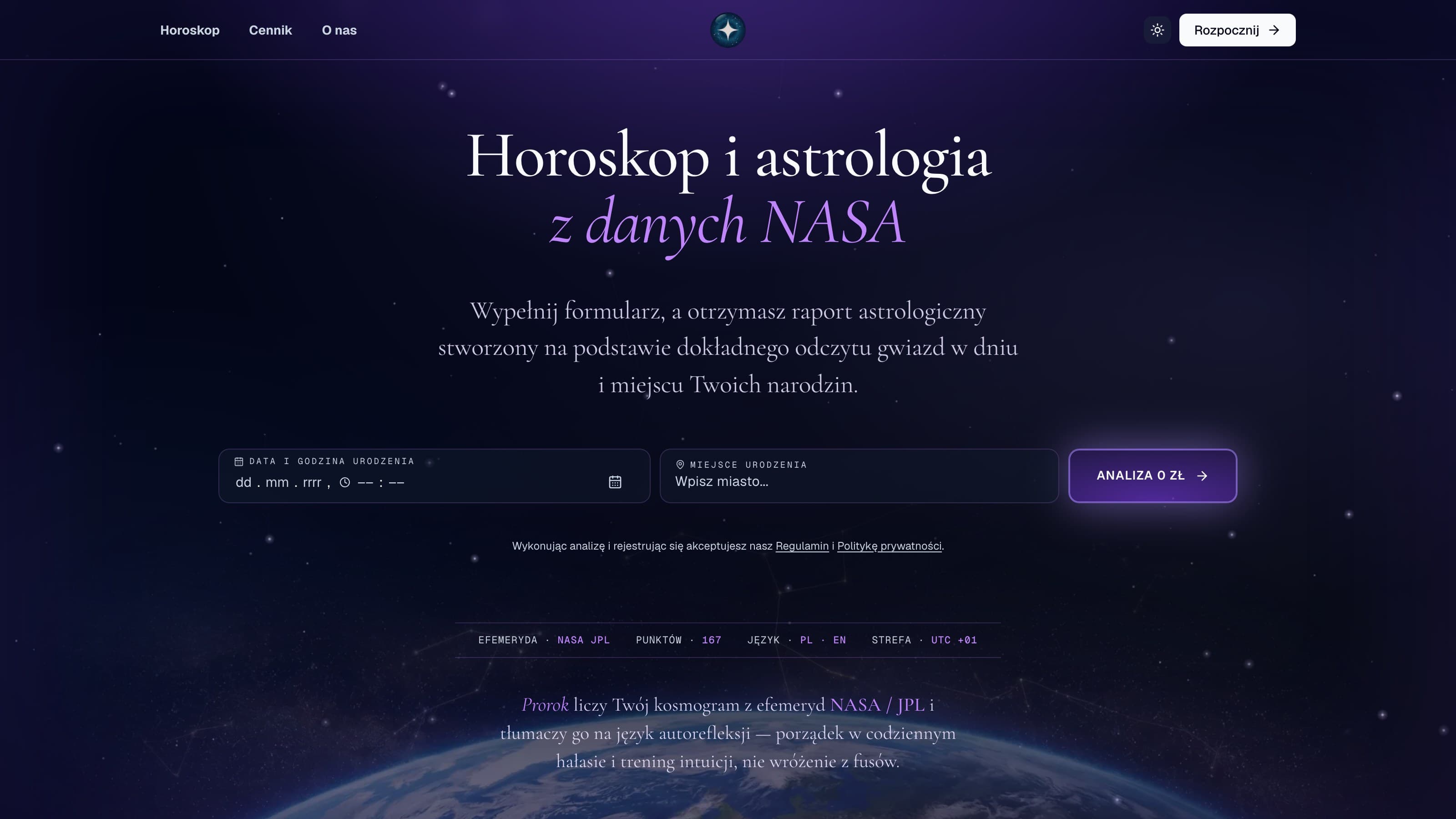
How I work // process
From sketch to production.
In weeks.
I don't start by writing the whole application, or with a quarter's worth of slides. I work like a sculptor: first an outline, then an ever-sharper shape — and you see and touch the result at every stage. I defuse the hardest parts first, so risk shrinks day by day instead of piling up until delivery day.

Architecture and proof it will work
First I sketch the architecture and immediately stand up a proof of concept of the hardest part — the one the project could fail on. If something is going to break, I'd rather know in the first days, not after two months. I defuse technical risk while changing course is still cheap.

Something you can click
I don't describe what it “will look like”. I build a fast, clickable prototype of the interface — alive, not a static picture. You're “touching” the product within days, and the conversation moves to specifics: this screen, this flow, this button.

Fit in a loop, not after the fact
We refine the prototype in short rounds: you review, I adjust. Misunderstandings surface on a clickable mock-up, not in production. That's the cheapest possible place for changes.

My own system ties it all together
Once the shape is signed off, I fire up the “secret weapon”: my own AI agent orchestration system. It fuses the prototype, logic, data and infrastructure into one working product. That engine delivers team velocity with single-person coherence.

Live, with safeguards built in
Finally I ship to production — with the same governance layers (the airlock below) built in from day one, not bolted on at the end. You walk away with a product ready for real traffic, not a “what if” deck.
The first three steps eliminate risk. The fourth — agent orchestration — eliminates time: not a faster way to type code, but a multiplier that lets one person deliver at a team's pace and quality.
Privacy built into the architecture
Between your data and the cloud
stands an airlock.
Sensitive data doesn't flow to the cloud in one stream. Documents stay on the machine (OCR runs locally), identity is swapped for reversible tokens, the response comes back and is unmasked locally, and the facts the model cites are checked against a local base. Only masked text ever crosses the machine boundary — governance built into the pipeline itself, not a policy in a PDF.

Documents never leave the machine
Scans, contracts, invoices — even your screen — read natively with Apple Vision, fully offline, no API key. What enters the pipeline is structured text, not the document image. A purely engineering side effect: ~97% fewer tokens (a 44-page PDF: ~2,400 instead of ~73,500).

Identity stays at the edge
PESEL numbers, IBANs, e-mails, names — 46 recognizers across 12 jurisdictions, with checksum validation (PESEL, Luhn, IBAN mod-97), swap data for reversible tokens like [PERSON:1], [PESEL:1] before the text leaves the machine. The cloud works on placeholders; the response is de-tokenized locally, and the mapping never leaves the session.

A fact either exists or it doesn't
The model cites a Polish court ruling? Before it lands in a document, the citation is checked against a local base of 1,348 rulings (SAOS / EUR-Lex, SQLite + FTS5): FOUND / NOT_FOUND / AMBIGUOUS in a fraction of a millisecond. Zero LLM at runtime — a hard index lookup, not “the model thinks so”.

The cloud sees only what's safe
These aren't three tools you run “when you remember” — they compose into one pipeline: OCR → mask → cloud → unmask → fact-check (exactly how sortai works). Only masked text ever crosses the machine boundary; documents, token mappings and the fact base stay put.
Most “vibe coders” send your data to the cloud and hope nothing leaks. I built an airlock raw data simply doesn't flow through — here, compliance and GDPR are a property of the architecture, not a promise.
Open-source arsenal · privacy-first
I see a problem, I build a tool.

About
15+ years of craft,
with AI added on top.
My name is Adrian Wołczuk. I've been building software for over 15 years — most recently as a Front-end Tech Lead at CGI, before that at KPMG and Acxiom. I'm strongest in architecture, design systems and — for the past few years — in orchestrating AI agents, which genuinely shortens the path from idea to production. I studied computer science (PJATK) and sociology (SWPS), because good software isn't just code — it's something people actually want to use.
Track record
Front-end Tech Lead @ CGI → KPMG → Acxiom. Staff-level front-end + design systems, technical leadership, architecture.
Education
Computer science (social computing, PJATK) + sociology (SWPS) — technology wired to people.
AI-augmented dev pioneer
Rolled out GitHub Copilot in his team back in 2024, before it became standard. Builds his own agent infrastructure alongside.
Lifelong builder
He was 14 when he designed, programmed (his own CMS in PHP/MySQL) and ran “Prorok Sieciowy” — one of Poland's biggest Harry Potter fandom portals. I've been building for as long as I can remember.
Teaching & training
AI-augmented development training. I run workshops and training sessions: from working with AI agents, through building your own MCP tools, to orchestration. You leave with a working workflow, not a slide deck.
Is your product stuck?
30 minutes is enough for me to tell you whether — and how — it can be shipped in weeks. No strings attached, no sales babble.